
This is one of the coldest temperatures achieved in a research facility in India with more than 80 per cent domestically sourced components.

The Indian government has notified the Legal Metrology (Indian Standard Time) Rules, 2026, establishing IST as the sole reference for all official purposes nationwide. These rules, effective in 180 days, aim to synchronise digital systems, reduce reliance on foreign time sources, and enhance coordination across critical sectors like banking, railways, and telecommunications.

A tech firm has delivered to the Army 106 turbojet-powered kamikaze drones designed to engage high-value targets deep inside enemy territory and operate in contested electromagnetic environments, according to a statement.

Hindustan Aeronautics Limited (HAL) has delivered LCA Tejas FOC twin-seater trainers and HTT-40 basic trainer aircraft to the Indian Air Force, and Dhruv next-generation helicopters to Pawan Hans. This significant handover, witnessed by Defence Minister Rajnath Singh, marks a crucial step in India's journey towards self-reliance in the aerospace sector, showcasing HAL's capabilities across military, civil rotary-wing, and pilot training aviation.

Andhra Pradesh is set to launch India's first indigenously built, open-access quantum computers, marking a significant step towards building a sovereign quantum hardware ecosystem. The initiative aims to position the state as a global hub for quantum technology and enable applications in various sectors.

Reliance Industries and Rolls-Royce on Friday said they intend to jointly develop a sovereign combat engine for the Advanced Medium Combat Aircraft (AMCA) programme, marking a bid by India's largest private-sector company and Britain's storied aero-engine maker to build indigenous fighter-jet propulsion capability in the country.
Reliance Industries and Rolls-Royce on Friday said they intend to jointly develop a sovereign combat engine for the Advanced Medium Combat Aircraft (AMCA) programme, marking a bid by India's largest private-sector company and Britain's storied aero-engine maker to build indigenous fighter-jet propulsion capability in the country.

'The Aravalli engine will power HAL's upcoming 13-tonne Indian Multi-Role Helicopter and its naval variant, the Deck-Based Multi-Role Helicopter.'

Andhra Pradesh is set to inaugurate India's first indigenously developed, open-access quantum computer test beds, Amaravati 1S and 1Q, at SRM University, marking a significant advancement in the nation's quantum computing capabilities.

Uttar Pradesh Governor Anandiben Patel addressed AI Manthan 2.0, advocating for the comprehensive integration of Artificial Intelligence across all university subjects rather than as a standalone course. She urged universities to develop clear, time-bound AI roadmaps covering education, research, healthcare, and agriculture, emphasising indigenous AI development, employment creation, and the importance of "Safe and Trusted AI." The event also saw the formation of an AI Policy Advisory Group and an AI Implementation Group to drive these initiatives.

State-run Oil and Natural Gas Corporation (ONGC) has made a significant gas discovery in the deep waters of the Mahanadi Basin off the Odisha coast, recording encouraging flow and sustained reservoir pressure, a breakthrough for India's deepwater exploration programme.

Sports Minister Mansukh Mandaviya will chair a two-day meeting of BRICS Sports and Youth Ministers in Visakhapatnam, aiming to strengthen cooperation in youth affairs and sports, with a focus on sports manufacturing, indigenous disciplines, and youth development.

The University of Delhi and semiconductor major AMD have signed a Memorandum of Understanding (MoU) to train up to 10,000 students and faculty in industry-relevant artificial intelligence skills over the next year. This collaboration will provide access to AMD's AI Engage Developer Programme, including its open-source ROCm AI software platform, learning resources, and developer GPU cloud credits, aiming to foster indigenous AI capabilities and bridge the gap between academia and industry.

Andhra Pradesh has launched India's first quantum reference facility, aiming to build a sovereign hardware ecosystem and boost indigenous manufacturing of advanced computing systems.

India is set to develop its first 100% hydrogen-powered Direct Reduced Iron (DRI) plant, a Rs 207-crore national pilot project led by CSIR-IMMT. This initiative aims to significantly reduce carbon emissions in the steel sector and achieve net-zero commitments, focusing on adapting the technology to India's domestic iron ore conditions.
Andhra Pradesh Chief Minister N Chandrababu Naidu marked World Telecommunication and Information Society Day by emphasising the state's growing quantum technologies ecosystem and the importance of secure digital infrastructure.

Netrasemi, an Indian semiconductor start-up, has announced that its flagship AI chipset, A2000, has achieved silicon bringup and is preparing for commercial production this year. The A2000 SoC, supported by Zoho and the government's DLI programme, will enable smart vision and real-time video analytics for smart cameras and edge AI platforms.

J R D Tata, chairman of the Tata group from 1938 to 1991, said that whenever he had to make a difficult decision, he would ask himself, what will be good for India, and what will be good for the Tatas. If he had a doubt, he would decide in favour of India. In the long run, it would turn out well for the Tatas too, he said, points out Arun Maira.

State-run defence major Hindustan Aeronautics Limited (HAL) has delivered LCA Tejas Final Operational Clearance twin-seater trainers and HTT-40 basic trainer aircraft to the Indian Air Force, along with Dhruv next-generation helicopters to Pawan Hans. This significant handover, witnessed by Defence Minister Rajnath Singh, marks a crucial step in India's journey towards self-reliance in the aerospace sector, showcasing HAL's diverse capabilities in military, civil, and training aviation.

Tashi Network and DroneVerse successfully conducted a live drone swarm field trial in Delhi, demonstrating advanced autonomous capabilities for defence and internal security. The trial showcased decentralised mesh technology, allowing drone swarms to maintain mission coherence even with communication disruptions, marking a significant step towards India's technological sovereignty in autonomous warfare.

The new range brings Ola's 46-series LFP cells to its most affordable scooter lineup aimed at India's mass-market electric vehicle (EV) buyers.

IIT Madras is hosting the 3rd Digital India RISC-V (DIR-V) Symposium 2026 in partnership with the Ministry of Electronics and Information Technology and RISC-V International. The symposium aims to unite stakeholders from government, industry, and academia to advance India's semiconductor innovation, focusing on indigenous processor technologies, secure computing, hardware innovation, and AI, aligning with the government's vision for India as a global semiconductor hub.

Experts at a discussion in Delhi emphasised the importance of ethical governance and indigenous capability in India's pursuit of becoming a global artificial intelligence power, ensuring technology serves the public good and maintains strategic autonomy.
Astrobase Space Technologies, a Bengaluru-based startup, has unveiled 'EVEREST', India's first privately built full-flow staged combustion (FFSC) LOX-Methane rocket engine. This advanced engine, designed for reusable medium-lift launch vehicles, aims to enhance India's position in the global space economy by providing high-performance propulsion systems for future satellite deployments.

Bharti Airtel's homegrown cloud platform, Airtel Cloud, has acquired approximately 40 customers within a year of its launch, with a significant portion coming from the manufacturing sector. The platform, designed for Indian companies, offers sovereign, telco-grade cloud infrastructure, connectivity, and GenAI-based provisioning, addressing the growing demand for secure, India-hosted data solutions, particularly for sensitive workloads and regulated sectors.

The move is meant to enhance the operational capability of the armed forces, reduce import dependence and increase domestic value addition.
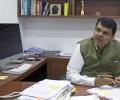
The Maharashtra government is setting up a ministerial task force, led by Minister Ashish Shelar, to ensure the effective implementation of its drone policy. Chief Minister Devendra Fadnavis announced this, emphasising the need for a "policy of policies" to integrate R&D, manufacturing, testing, and subsidies, and to strengthen the state's drone ecosystem, including developing a 'Drone City'.

Air Chief Marshal A P Singh, the IAF chief, has strongly advocated for India to achieve greater self-reliance in unmanned aerial systems and other critical defence technologies, stating, "Technology delayed is technology denied." He stressed the importance of indigenous development to avoid dependency on other countries for components.
Indigenous smartphone brand Ai+ has announced a Rs 100 crore bug bounty program over five years, inviting independent researchers to identify and address security vulnerabilities. This initiative, named Project Trust+, aims to foster a collaborative environment with the tech community to enhance the safety and resilience of Ai+ products, reflecting the company's commitment to transparent and collaborative security development.

Specialised range taking shape in Andhra Pradesh, while West Bengal clears way for DRDO's new testing facility.

Construction of the approved reactor projects is expected to take five to six years after receiving financial approval.
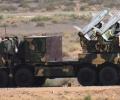
India's defence sector is on the cusp of a 'super cycle' of growth, driven by escalating geopolitical conflicts and a strong policy push towards indigenous manufacturing, with major players like BEL, HAL, and BDL poised for significant order inflows and technological advancements.

'It is not economical to operate GSLV-Mk II due to its cost and complexity. Future launches to be managed with LVM3.'
HCLTech, India's third-largest IT services company, announced plans to establish a global technology centre and an AI-optimised data centre in Bhubaneswar, Odisha, with a total investment of approximately Rs 15,000 crore, marking its entry into the AI infrastructure business.

'India is trying to project that it can engage with the world in a different way too.'

Union Telecom Minister Jyotiraditya Scindia launched the cell broadcast alert system, developed indigenously, to warn citizens about emergencies and natural disasters in their area. The system is now operational across all states and union territories.

The government introduced the SHANTI Act, 2025, to support the mission and open the sector to private participation.

Tata Motors Passenger Vehicles Ltd (TMPV) has launched its new brand identity, TATA.CARS, aiming to appeal to a younger demographic with a focus on smarter, greener, and more connected mobility experiences.

India has commissioned its new indigenously-built nuclear-powered ballistic missile submarine INS Aridaman into service, further strengthening the naval component of its nuclear triad. Defence Minister Rajnath Singh also highlighted the Indian Navy's role in securing maritime trade routes.
Union Minister Ashwini Vaishnaw chaired a meeting focusing on Artificial Intelligence, emerging technologies, and electronics hardware manufacturing, highlighting India's progress and future roadmap in these sectors.
